About the contract
What is the contract and what can it do for you?
Streams and frames
A ROS 2 robot publishes topics. Each has its own message type, its own rate, and its own clock. A policy doesn’t consume topics. It consumes regularly Intervaled frames. At every tick, one array per key, always the same keys, always the same shapes.
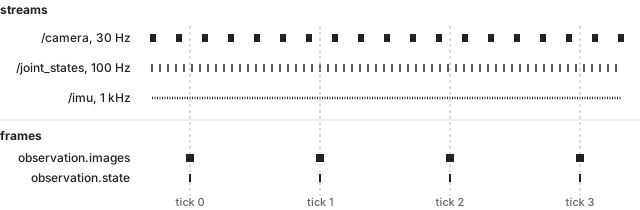
Turning topics into frames means deciding which data from you stream belongs to which fields, and which tick of a frame.
The contract those provides align, select and apply to define the time, shape, and values components of the transform from stream to frame.
Before or after recording
LeRobot’s Robot class makes those decisions in code. get_observation()
hands back a frames. This is nice because it is compact, and ready to train on.
But anything the class didn’t emit is gone. Want a
different image size, one more joint, a different alignment rule? You might be stuck re-recording.
Rosetta makes the decisions after recording. You record your data raw, as bags, with every message at its own rate and stamp, on every topic. The contract enforces transforms only in preparation for training, and again when you run the policy. If you change it, you prepare and train again.
The same code, twice
Two copies of one transform risk drifting apart. Say data preparation resizes with one library and inference uses another. Nothing crashes. The policy will likely just perform a little worse than it should.
So both paths run the same three classes. StreamIngest reads a message on
its timeline, selects the fields and applies the operators. StreamBuffer
picks the sample for each tick. FrameLayout lays the values out under
their keys. Offline, bag_frames feeds them from a bag. Live, TopicBridge
feeds them from subscriptions.
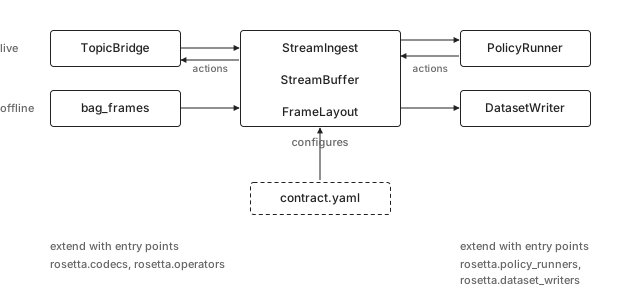
A test in the repo feeds the same messages through StreamBuffer and
FrameLayout by hand and checks the porter’s output against them frame for
frame. One caveat: a stream aligned on
receive uses the bag’s receive stamp offline and the node clock live, so it
replays closely, not exactly. A stream aligned on header replays bit for
bit.
Actions go the other way, live only. FrameLayout splits the action vector,
the operators run in reverse, and an encoder builds the message.
Where the contract stops
At the dataset. Frames come out in robot units, named and shaped the way the dataset stores them. Normalization, batching and tokenization are the framework’s job and travel with the checkpoint. LeRobot saves its processors next to the weights. So the contract keeps the robot side the same between building and serving, and the checkpoint keeps the model side the same.
The contract also travels with the data. The recorder writes it into each bag’s metadata, and the porter writes the contract it was given into the dataset. A policy runner started without a contract path follows the checkpoint back to its training dataset and reads the contract there.
Frameworks
The robot side turns ROS 2 into frames. The policy side turns frames into a
dataset or into actions. Neither imports the other. rosetta_port joins
them offline and policy_runner_node joins them live, each looking the
framework up by name.
Entry points extend this. rosetta.codecs adds message types,
rosetta.operators adds value transforms, rosetta.dataset_writers and
rosetta.policy_runners add a framework. A contract names message types and
operators but never a framework.
One numeric key on the live path
The porter writes one dataset feature per contract key. LeRobot’s live path
does not: its feature builder produces one observation.state for all numeric
observations and one action for all actions. A contract with two numeric
observation keys ports and trains fine, then fails when the robot connects.
Rosetta checks this where LeRobot is involved, in the Robot plugin’s
connect() and in the policy runner’s configure step. The contract loader
doesn’t check it, since the contract isn’t tied to LeRobot. If you hit the
limit, merge the streams into one multi-source key.
Unstamped messages
A message aligned on header with a stamp of (0, 0) is dropped. Rosetta
doesn’t fill in the arrival time. If it did, a driver that forgets to stamp
would look fine in a dataset and behave differently live. The drop is logged
once, and so is recovery. A message honestly stamped at the epoch is lost
too.